
Pebbledash divides opinion. Some homeowners love its traditional look; many more would happily see the back of it. If your home is pebbledashed or covered in tired, dated render, you may be wondering whether external wall insulation (EWI) can simply go over the top—or whether everything has to come off first.
The answer, in most cases, is encouraging: external wall insulation can often be installed directly over pebbledash or existing render, transforming both the performance and the appearance of your home in one project. But suitability depends entirely on the condition of what’s already on the wall.
When Is the Existing Surface Suitable?
The golden rule is stability. If the pebbledash or render is sound, well-bonded, and free from major cracking, it can usually stay in place. Installers test this by tapping across the surface—a solid sound means the coating is firmly attached, while a hollow sound reveals areas that have come away from the wall behind (known as “blown” render).
A surveyor will also check that the wall is dry and free from underlying problems, that the existing coating isn’t trapping moisture, and that the substrate behind it (brick, block, or stone) is structurally sound. If the majority of the surface passes these checks, insulating over the top is normally the quickest and most cost-effective route.
When Does Render Need to Be Removed or Repaired?
Not every wall gets a clean bill of health. Removal or repair is usually needed when large areas of render or pebbledash sound hollow or are visibly coming away, when there is significant cracking that suggests movement or water ingress, or when damp is trapped behind the existing coating. Loose sections can’t simply be covered up—fixing insulation to an unstable surface risks the whole system failing later.
In many cases, only patch repairs are required: degraded sections are stripped back and made good, while the sound areas stay put. Full removal is the exception rather than the rule, but where it’s needed, it’s far cheaper to address it before installation than after.
How the Wall Is Prepared
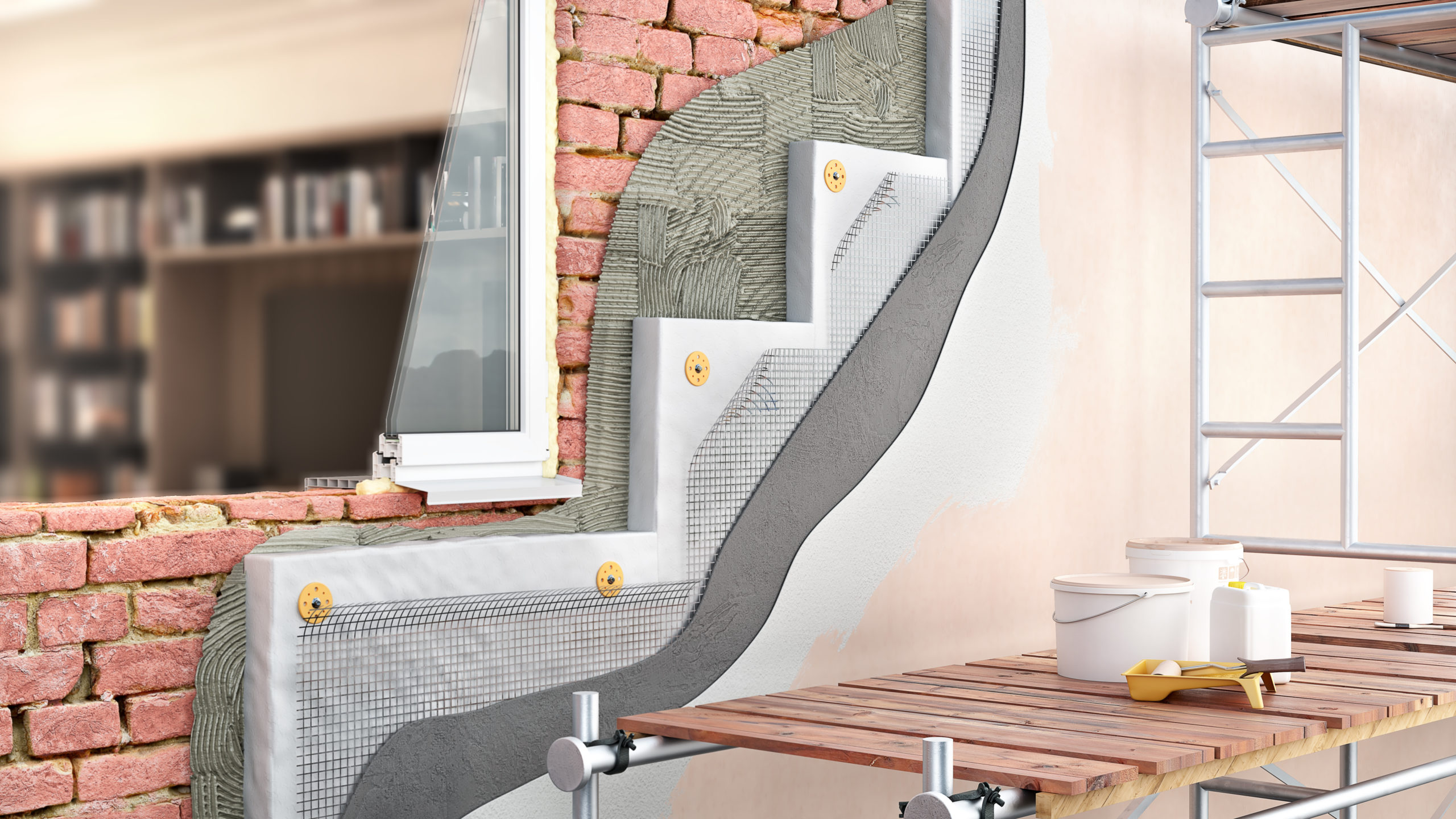
Good preparation is what separates a 25-year system from a five-year problem. Before any boards go on, the wall is cleaned and any organic growth treated, loose material is removed and repaired, and a stabilising primer is applied to give the adhesive a reliable surface to grip. Insulation boards are then bonded to the wall and—crucially—secured with mechanical fixings that pass through the old coating and anchor into the structural wall behind. This means the system never relies on the pebbledash alone to hold it up.
Moisture Checks Matter
Older rendered and pebbledashed homes often hide damp issues, and sealing moisture into a wall is the one mistake you can’t easily undo. A professional installer will check moisture levels before work begins, identify and fix the source of any damp—leaking gutters, failed pointing, bridged damp courses—and specify a breathable system where the property needs to release moisture vapour naturally. Done properly, EWI actually protects the wall from driving rain and reduces the risk of damp rather than causing it.
Finish Options: Goodbye Pebbledash
This is where the transformation happens. Once the insulation is on, you can choose from smooth, modern thin-coat renders in virtually any colour, textured finishes for a softer, traditional look, or brick-effect slips if you want to restore a classic brick appearance. The result is a home that’s warmer, quieter, and—for many owners—almost unrecognisable from the kerb.
Common Mistakes to Avoid
The failures we’re asked to put right almost always trace back to the same errors: insulating over loose or damp render, skipping mechanical fixings, using a non-breathable system on a wall that needs to breathe, and ignoring details like window reveals, cills, and verges where gaps let heat and water in. Cheap quotes that skip the survey stage are usually cheap for a reason.
Find Out If Your Walls Are Suitable
Every pebbledashed home is different, and the only way to know for certain is a proper assessment. Therm-eco’s surveyors check the condition of your existing render, test for moisture, and recommend the right system and finish for your property. Book a free, no-obligation survey today and see what your home could look like without the pebbledash.
FAQ: External Wall Insulation Over Pebbledash and Render
Q: Can external wall insulation be fitted over pebbledash? Yes—provided the pebbledash is stable and well-bonded, insulation boards can be fixed directly over it, with mechanical fixings anchored into the structural wall behind.
Q: Does old render have to be removed first? Only if it’s loose, badly cracked, or trapping damp. Sound render can stay; degraded areas are repaired or stripped back before installation.
Q: How do installers know if my pebbledash is suitable? A surveyor taps across the surface to detect hollow, “blown” areas and checks for cracking and moisture before recommending whether to insulate over it.
Q: Will EWI over pebbledash cause damp? Not when installed correctly. Moisture levels are checked first, any damp sources are fixed, and breathable systems are used where the wall needs to release moisture.
Q: What finishes can replace the pebbledash look? Smooth or textured coloured renders and brick-effect slips are the most popular choices—giving your home a completely refreshed exterior as well as better insulation.